
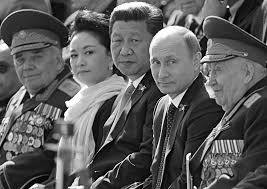
In a powerful and meticulously orchestrated display of strategic partnership, Chinese leader Xi Jinping and Russian President Vladimir Putin convened for a series of high-level meetings in Beijing, solidifying a bond that has grown ever stronger in recent years. The talks, which saw the two leaders address each other as “old friend” and “dear friend,” were not merely a reaffirmation of bilateral ties but a potent message to the United States and its Western allies, underscoring a shared vision for a new, multipolar world order. This diplomatic summit, which coincided with the 80th anniversary of the end of World War II, served as a historical and contemporary rebuke to what they perceive as the U.S.-led “Euro-Atlantic” system of global dominance.
The meetings, which began at the Great Hall of the People and continued with a more intimate tea gathering, came on the heels of the Shanghai Cooperation Organization (SCO) summit in Tianjin. The SCO, which includes India and several other Eurasian nations, has been a vehicle for Beijing and Moscow to promote an alternative to Western-led alliances. At the summit, President Xi had already laid the groundwork for this new vision, criticizing “bullying behavior” and “cold war mentality” and proposing a “Global Governance Initiative” that would be more “just and equitable.” This thinly veiled critique of American foreign policy resonated strongly with Putin, who, in turn, blamed the West for provoking the conflict in Ukraine.
The deep-seated camaraderie between the two leaders, which seems genuinely warm despite the criticism from Western capitals, is rooted in both historical solidarity and contemporary necessity. Putin himself invoked the shared past, noting that the Soviet Union had assisted China in its fight against invading Japanese forces during World War II. “We were always together then, we remain together now,” he stated, highlighting a historical bond that transcends mere political convenience. This historical narrative is particularly potent as both nations seek to frame themselves as the rightful victors of a global conflict, thereby establishing a moral authority to reshape the current geopolitical landscape.
The strategic alignment of China and Russia has profound economic and political implications. With Western sanctions still in place against Moscow for its actions in Ukraine, China has provided a critical economic lifeline through continued trade, including significant purchases of Russian oil. This economic cooperation extends to new agreements, with a Russian state gas company signing deals to increase deliveries to China. A visa-free travel agreement for Russian tourists also signals a deeper integration. This growing economic interdependency is a clear sign that the two nations are building a fortress against Western sanctions, demonstrating a capacity to not only withstand but thrive outside of the U.S.-dominated financial system.
Furthermore, the diplomatic unity on display in Beijing is a direct challenge to American foreign policy. The two leaders are effectively using their combined influence to pull other nations, particularly those in the Global South, into their orbit. The trilateral meeting with Mongolian President Khurelsukh Ukhnaa and the broader SCO summit, which included Indian Prime Minister Narendra Modi, are a testament to this strategy. The presence of these leaders, particularly Modi, whose nation has faced escalating trade tensions with the U.S. under the Trump administration, demonstrates a growing willingness to embrace a new, multipolar world. The optics of the meetings sent a powerful message: that the world’s most powerful nations are no longer exclusively Western, and that a new alignment of power is taking shape with Beijing and Moscow at its core.
The visit culminated on a highly symbolic note as Putin was set to attend a grand Chinese military parade marking the 80th anniversary of Japan’s surrender. The parade, which was also expected to be attended by North Korean leader Kim Jong Un and Iranian President Masoud Pezeshkian, was an unambiguous show of military might and defiance. For Putin, it was an opportunity to send a clear message to Europe that claims of a Russian attack are “hysteria.” For Xi, it was a moment to showcase China’s military prowess and to demonstrate to the world that countries the U.S. and its allies consider “outcasts” are, in fact, powerful and united. This collective display of strength signals that the China-Russia partnership is not a passing moment of convenience but a durable, strategic alliance poised to challenge the status quo and shape the future of global governance.
Leave a Reply