
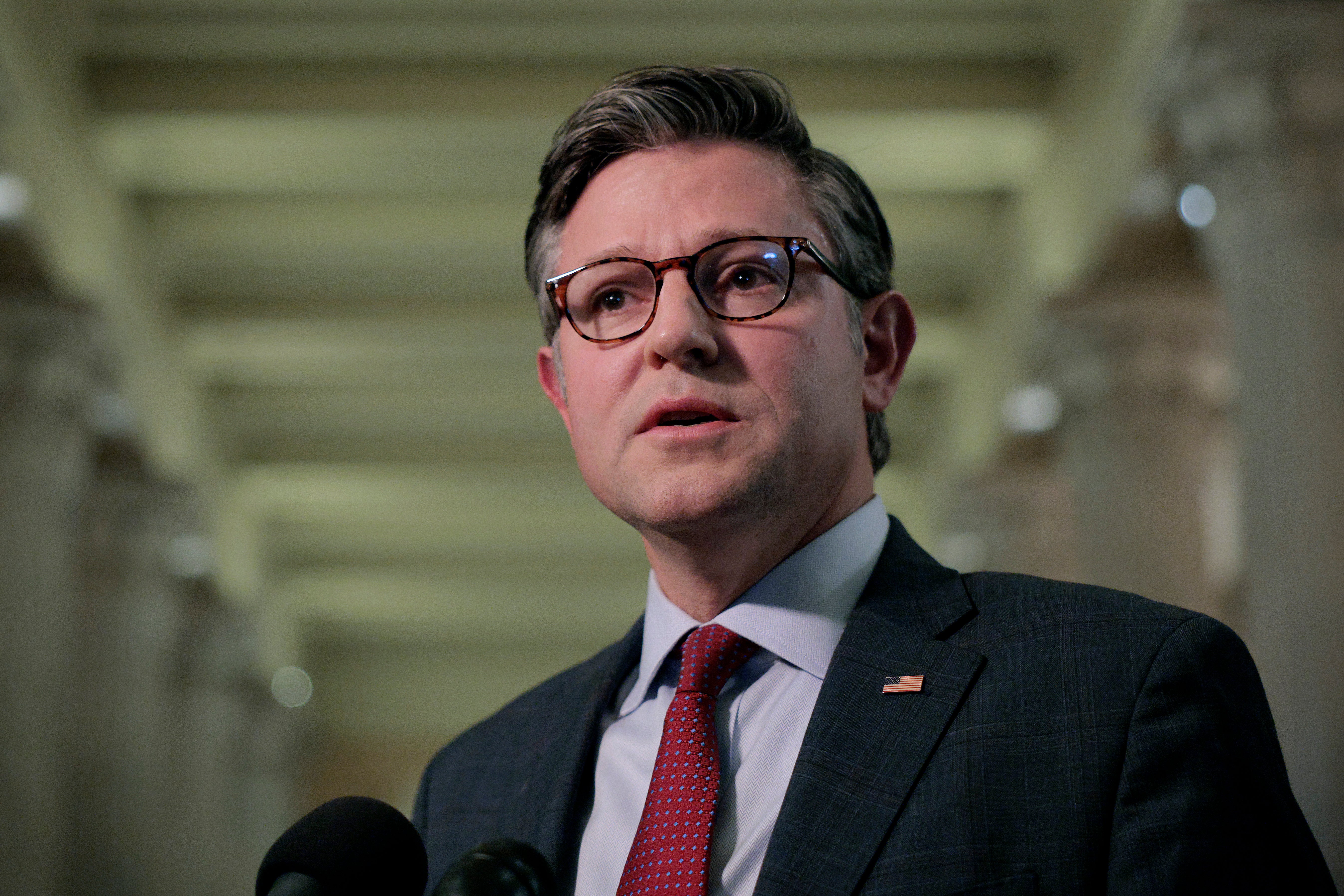
A political firestorm erupted in Washington, D.C. after House Speaker Mike Johnson made the startling claim that Donald Trump was an “FBI informant” who worked to bring down disgraced financier and convicted sex offender Jeffrey Epstein. The statement, which came as Johnson sought to defend Trump’s recent dismissal of the Epstein case as a “Democrat hoax,” sent shockwaves through the political landscape and was quickly walked back by the Speaker’s office, leading to confusion and criticism from all sides.1 The unfolding drama has intensified the bipartisan push for the release of all government documents related to Epstein, a demand that has been met with resistance and conflicting messages from the Trump administration.
Johnson’s initial claim was made to reporters at the Capitol, where he was asked to reconcile Trump’s recent comments—in which the president called the push for transparency a “hoax”—with the fact that many Republicans, including members of his own party, are calling for the release of the files.2 The Speaker insisted that Trump was not dismissing the seriousness of Epstein’s crimes, which he called “a terrible, unspeakable evil,” but rather the “hoax” of the political attack against him. To further his defense, Johnson then stated, “He was an FBI informant to try and take this stuff down.” This explosive assertion was met with immediate skepticism and confusion, even from former Trump officials.
Just days later, Johnson’s office issued a statement that significantly softened the claim. The new statement clarified that the Speaker was “reiterating what the victims’ attorney said,” and that Trump was “the only one more than a decade ago willing to help prosecutors expose Epstein for being a disgusting child predator.”3 This re-framing of the president’s role shifted it from a formal law enforcement collaboration to an informal effort to assist. It referred to comments made by Brad Edwards, an attorney for several of Epstein’s victims, who had told reporters that Trump had been helpful to his investigation in 2009.4 Edwards, however, did not say at the time whether Trump had cooperated with the FBI, only that he had “gotten on the phone” and provided information that was useful to their efforts.5
The controversy highlights the complex and often contradictory nature of the Epstein case in the current political climate. For years, Trump and Epstein were known to be onetime friends who socialized in similar circles before a falling-out around 2004.6 The reason for their split has been attributed to a property dispute and an incident where Epstein acted inappropriately toward a member’s daughter at Trump’s Mar-a-Lago resort. Despite this, Trump has continued to face scrutiny over his past relationship with Epstein, and his recent attempts to dismiss the calls for transparency as a “hoax” have been met with a strong backlash from victims, who insist that their trauma is not a partisan issue.7
The political maneuvering around the issue also points to a growing rift within the Republican Party. While Johnson has opposed a bipartisan bill that would compel the release of the Epstein files, a group of Republicans, including Representative Thomas Massie, has joined with Democrats to push the legislation forward.8 Massie has publicly questioned Johnson’s initial claim, saying that being an “informant” implies a formal, ongoing relationship with the FBI, and asked why Trump would have been an informant to a “hoax.”9 This has created a difficult situation for Johnson, who is caught between a bipartisan coalition demanding transparency and a need to defend the president against perceived attacks. The controversy has not only added a new layer of complexity to the Epstein saga but has also underscored the ongoing power struggles within the Republican Party and the challenges of managing a narrative that refuses to go away.
Leave a Reply